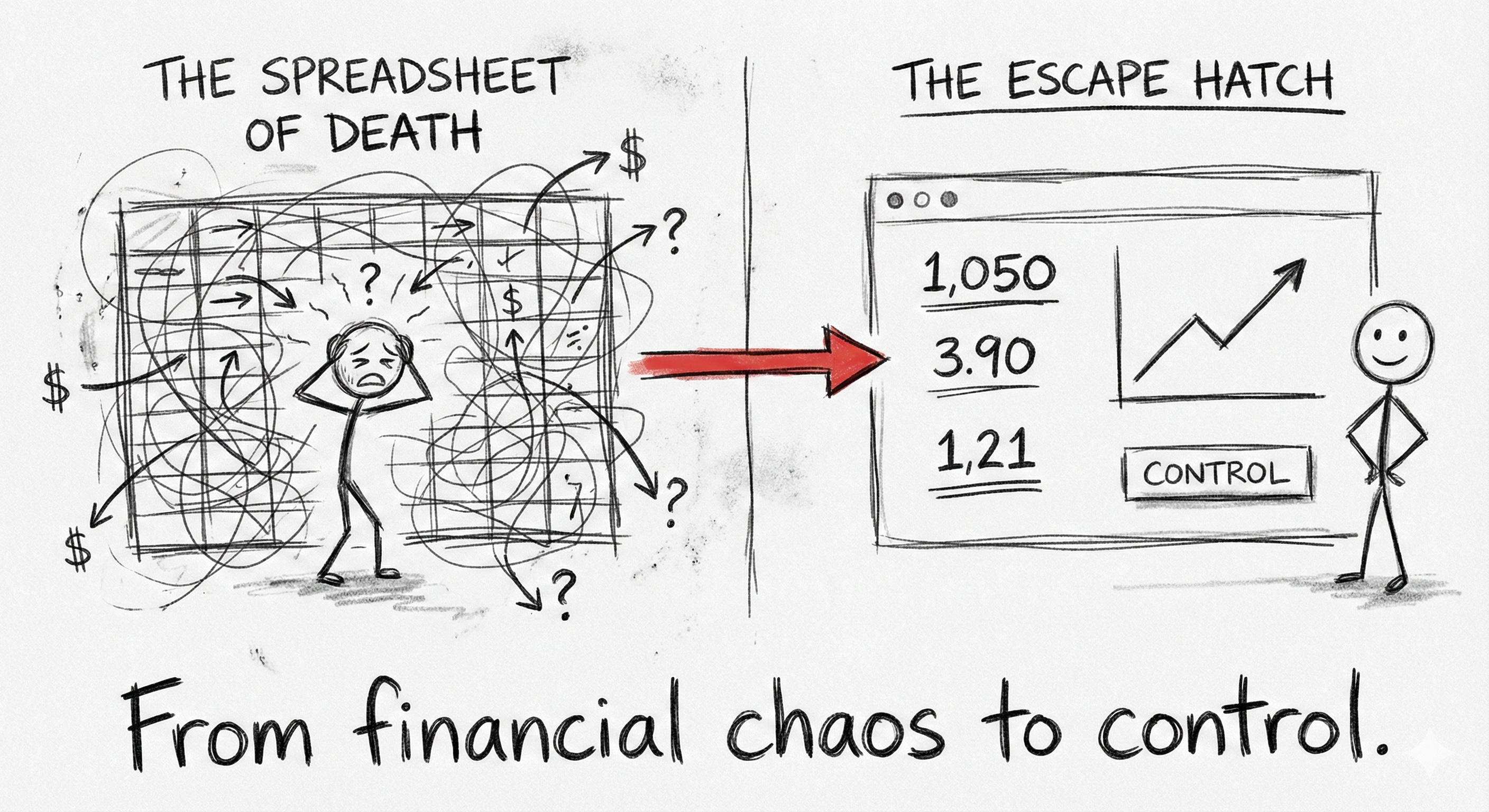
The Spreadsheet Is Where Startups Go to Die
This is a blueprint for building a tool for saving founders from their own financial chaos.
Tab 27. That’s when the panic sets in.
You know the one. It’s called Invoices_Q3_Master_FINAL_v2. It’s where you track who owes you money, who you owe money to, and the vague, terrifying number you think is your burn rate. It started so simple. So clean. And now it’s a monster. A multi-headed hydra of VLOOKUPs and conditional formatting that groans every time you open it.
This isn’t a hypothetical. This is the rite of passage for every founder who survives long enough to make money. The free tools that got you here are now the anchor dragging you to the bottom.
The Cries for Help are Everywhere
A founder on Reddit laid it all out. They’re drowning in a sea of Notion pages and Google Sheets. They confessed to “delayed invoicing and trouble with tracking vendor payments.” They feel stuck. They know SAP is a sledgehammer for a thumbtack, but their current toolkit is failing them.
And then, in the comments, the real horror stories appear. The stuff that keeps CPAs up at night.
I fully depreciated a copier that was like 30k. But they didn’t buy it, it was a copier lease. The partner didn’t catch it.
(okay, I might have exagerated with horror story, but you get the point)
A spreadsheet doesn’t know what a lease is. It’s just a cell. A number. A human mistake that the system accepts, no questions asked. Another commenter nailed the entire point of what founders are really looking for:
what i’m trying to solve is that the system doesn’t add its own category of mistakes on top of that. Meaning that even if the human mis-classifies, the ledger itself stays internally consistent… and we can show exactly what happened later.
That’s it. That’s the whole damn thing.
They don’t want a robot. They just want a safety net. A system that has their back when they’re moving too fast and making tired, human errors.
PS: you can read the reddit thread here.
Build Them a Financial Cockpit
Let’s call it Control.
This is not another accounting platform. It’s a single pane of glass for a startup’s money. It does one thing: it pulls every critical financial signal into one beautiful dashboard and lets you take action. Send an invoice. Flag an expense. See your cash balance.
That’s it.
We are not building QuickBooks. We are not building NetSuite. We are building the perfect escape hatch for the founder graduating from spreadsheet hell.
And for a solopreneur, I find this a perfect project. We’re building a clean, intuitive interface on top of APIs that already exist. You’re selling clarity, not a whole new ledger.
The Weekend MVP
You can get a working version of this live in a few weeks. Here’s the plan.
Plug into the money. Use Plaid for bank accounts. Use Stripe for payments. This is the central nervous system. Without real-time data, the product is dead on arrival.
Dead-simple invoicing. A single page. Create an invoice, connect it with their Google account, and track the status. Sent. Viewed. Paid. When it’s paid, the money goes straight to their Stripe account. You just move the data.
The one-page dashboard. This is the heart of it. Four numbers. Cash In. Cash Out. Money Owed to You. A running feed of every transaction. Nothing else. No fancy reports. Just the vital signs.
Your real challenge isn’t the code. The APIs from Plaid and Stripe are rock-solid.
The real challenge is trust.
We’re are asking a business owner to hand you the keys to their financial kingdom. As a solo founder with a new product, you need to be obsessed with security and professionalism from day one. Your website, your copy, and your face have to radiate one single message: I take your data more seriously than I take my own life.
Price It Like a No-Brainer
$49/month.
Flat. No tiers. No “per-seat” nonsense.
The pitch is simple: “This costs less than one hour of a bookkeeper’s time. If it saves you from one screw-up or gets one invoice paid a day faster, it pays for itself forever.”
Anchor the price to the pain you are solving.
Don’t Write a Single Line of Code
Stop. Before you open your editor, you need to prove people want this.
Build the Ghost Ship. Buy a domain. Use Carrd to build a gorgeous landing page in a single afternoon. Create beautiful mockups of the dashboard. Your headline is something like: “Your Startup’s Finances, Finally Under Control.”
Add the Bait. Put a simple email form on the page. The button says: “Request Early Access.” You have just created a product that looks 100% real for the cost of a few pizzas.
Go Hunting. Go to Reddit threads where founders are complaining. Don’t just start advertising as you’ll get shot down on the spot. Try to help others and after establishing a raport then ask for an opinion. Ask them to sign up. Or you know, take a shortcut and post some ads. Easier, faster but not necessarily better
The Interrogation. When someone signs up, email them immediately. Get on a 15-minute call. Ask them to show you their current spreadsheet mess. Their answers are your product roadmap.
Find one, just one, person from that list who is desperate. Offer to be their “manual Control” for a month for $50. Log into their stuff yourself. Build them a private dashboard. Send their invoices for them.
If someone will pay you to do this job manually, you don’t have an idea anymore. You have a business. 🎉
The gap between “free and broken” and “expensive and bloated” is where fortunes are made. You don’t need a revolutionary idea. You just need to build a better boat for the people who are drowning.
So, how many tabs are you at?