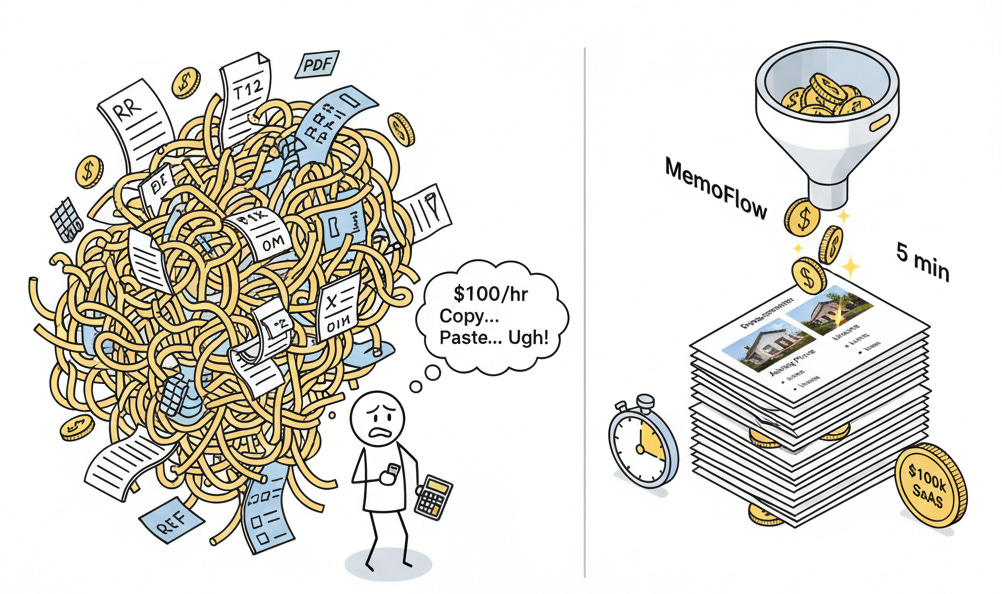
The $100k Analyst’s Copy-Paste Problem: A Blueprint for a Real Estate Micro-SaaS
A step-by-step guide to turning a common industry complaint into a profitable Micro-SaaS.
A real estate analyst, likely earning over $100,000 a year, recently posted a question on Reddit that stopped me in my tracks: How do you guys automate your work?
He was drowning in the boring stuff. Tracking deals, chasing brokers, and manually drafting investment decks. This was a map to a hidden treasure💡
I’m going to show you how a single Reddit comment reveals a painful, expensive problem for an entire industry. Then, I’ll give you the step-by-step playbook to build a simple software solution, validate it without writing code, and price it as an absolute no-brainer.
You can read the post here.
The Comments reveal the issue
The original post was simple, but the comment section revealed the issue.
They use a bit of Excel, a dash of Airtable, maybe some custom code, and a lot of manual labor.
When you see a dozen different people suggesting a dozen different tools for one problem, it means one thing: no one has built the perfect tool yet. The market is telling us it needs a focused solution.
But one comment stood out from the rest. It was from someone already building a piece of the puzzle:
I’m currently building something in this space for multifam acquisitions underwriting.
Basically all you need to do is send an email with the RR, T12, and OM (optional) and you get back a solid “first pass” underwritten deal in your company’s own underwriting model… Honestly it works pretty well, we are at about ~97% pass rate in our testing evals meaning 97% of test properties have 0 errors…
This comment exposes two critical pain points:
The Agony of Data Entry: Analysts get documents in messy formats: a Rent Roll (RR), a Trailing-12 Month financial statement (T12), an Offering Memorandum (OM). These are just PDFs and spreadsheets. Someone has to manually read them and type the numbers into a financial model. This is slow, boring, and a single typo can derail a multi-million dollar deal.
The Desperate Need for Speed: In commercial real estate, you might analyze a hundred deals to find one good one. The faster you can say “no” to bad deals, the more time you have to find great ones. The key phrase here is “first pass” analysis. The goal isn’t to replace the analyst; it’s to eliminate the initial, repetitive grunt work.
This is our entry point. The friction isn’t some complex, end-to-end deal management system. It’s that moment an analyst gets an email with three messy attachments and sighs, knowing they have an hour of data entry ahead of them.
From Messy Docs to Clean Report: Introducing “MemoFlow”
Let’s build a tool that solves this one, tiny, painful step. We’ll call it MemoFlow.
MemoFlow does one thing perfectly: It takes a folder of raw real estate documents and automatically generates a clean, professional, one-page investment summary.
That’s it.
An analyst uploads the Offering Memorandum, the T12, and the Rent Roll. They click a button. A few minutes later, a beautiful PDF summarizing the deal appears. It has the property photo, address, asking price, price per unit, occupancy rate, and key financials.
This isn’t a complex financial modeling tool. It’s not a CRM. It’s a document-to-summary machine.
This is the perfect Micro-SaaS for a solo founder because it’s hyper-focused. You’re not trying to build a better Salesforce. You are building a small, efficient robot that does one task incredibly well. You can market it directly to acquisitions analysts on LinkedIn and Reddit because you know exactly who your customer is and what they complain about.
The Step-by-Step Blueprint to Build It
This is more than a fun idea. Here is how you could actually build it.
The MVP (Minimum Viable Product)
What’s the absolute minimum you need? Forget fancy dashboards.
A Simple Uploader: A webpage where a user can drag and drop a few files (PDFs, Excel sheets).
An AI Extractor: The backend magic. Uploaded files are sent to an AI model (like Gemini 2.5 Flash) with a very specific prompt. The prompt instructs the AI to act as a real estate analyst and extract key data: Address, Asking Price, Number of Units, Gross Income, Operating Expenses, etc.
A Single PDF Template: You have one, beautifully designed one-page template. The AI-extracted data is plugged directly into this template. No customization.
Email Delivery: Once the PDF is generated, you email it to the user. The MVP doesn’t even need a results page. The whole experience is: upload → wait for email. 🎉
You can build this with off-the-shelf tools and APIs. You’re not inventing new technology; you’re connecting existing pipes in a clever way.
The Real Challenge: Trust & Accuracy
The main boss battle here isn’t code; it’s trust. No analyst will use a tool that makes mistakes with million-dollar numbers.
How do you solve this? You don’t promise perfection.
You market MemoFlow as a tool to create the first draft. Its job is to save the analyst 90% of the initial setup time. The analyst is still responsible for double-checking the numbers. Your MVP could even include a “confidence score” for each piece of data, highlighting numbers it was unsure about. Transparency is everything.
Pricing: The “No-Brainer” Offer 💰
Keep it dead simple.
Offer: $49/month for 20 memos.
An acquisitions analyst earns around $50 an hour. Research from firms like UiPath shows that the average knowledge worker wastes over four hours a week on tasks that can be automated. If MemoFlow saves an analyst just one hour of tedious work a month, it has already paid for itself. If it helps them find one extra good deal per year, the return on investment is astronomical.
Don’t Build a Thing… Yet.
The worst thing you can do is spend three months building something nobody wants. So let’s test this without writing a single line of code.
Step 0: The “Fake It ’Til You Make It” Test
Build a simple landing page (using Carrd or Framer). The headline: “Stop Manually Creating Deal Memos. Get a Pro Summary in 5 Minutes.”
Explain the process: Upload your docs, get a clean one-page PDF back.
Add a button: “Get Your First Memo Free.”
Link the button to a simple form (Tally or Google Forms) where they enter their email and upload their files.
Now for the secret: For the first few users, you are the software.
When someone submits the form, you get an email. You personally open the documents, pull out the key info, plug it into a Canva template you designed, and email the PDF back to them.
This manual process will teach you two critical things:
Demand: Will anyone actually use this? Are people willing to upload sensitive documents to a random website?
Requirements: What information do they really care about? You’ll see exactly what’s in their documents and what’s missing from your template.
If people start using your manual service, you’re onto something. Talk to every single user. Refine your template based on their feedback. Spend time in r/CommercialRealEstate and on real estate Twitter. Learn their language.
A New Way of Seeing
The internet is overflowing with opportunities disguised as complaints. Your next business idea won’t come from a grand vision. It will come from a frustrated comment on Reddit, a desperate question on a forum, or a tweet from someone sick of their spreadsheet.
You just need to learn how to see them.
What’s the most repetitive, ‘dumb’ task you’ve seen in your own industry that could be automated? I’d love to read your ideas in the comments.