
#31 — Epson Declared Your Printer Dead. It Isn’t.
A $9-per-reset ransom hiding a business idea you can build this weekend.

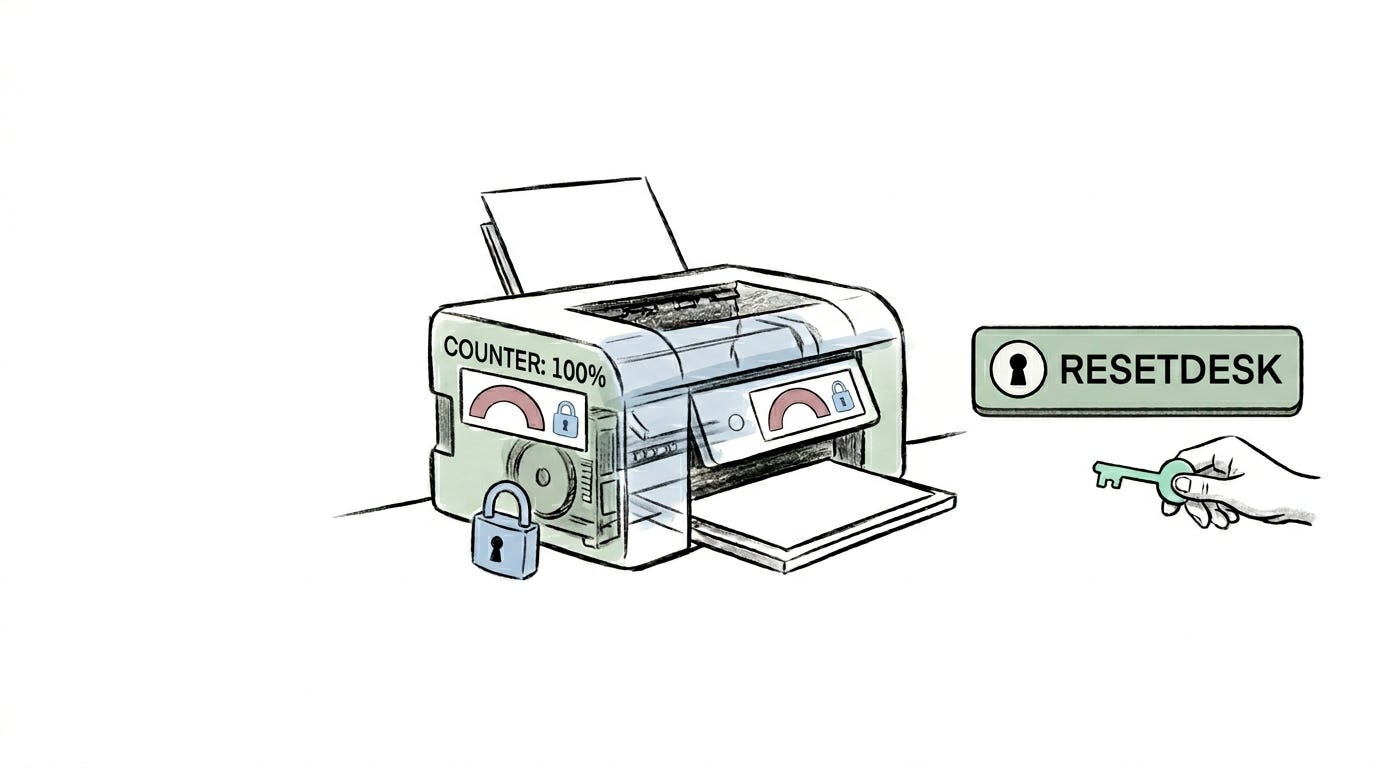
The printer was fine.
58,973 pages. Still running. Still printing. And then one morning, both LEDs started blinking — the printer equivalent of crossing its arms and refusing to work.
A quick Google/ChatGPT search delivered the diagnosis: “waste ink pad full.” An internal counter, buried in the EEPROM chip on the printer’s motherboard, had ticked past its limit. The printer was locked. Not broken. Not worn out. Just locked.
By software.
I wandered into r/printers last month and found a post from someone who’d hit this exact wall with their Epson L222. What they found when they went looking for a fix stopped me cold. Here’s how they described it:
“The alternatives were bleak: the official Epson AdjProg utility is scattered across shady websites and packed with who-knows-what trojans, and the ‘free’ WIC Reset tool only resets the counter to 80% before aggressively demanding you buy a key.”
You can read the full thread here: r/printers on Reddit.
Read that again.
Your printer is working perfectly. The counter says it isn’t. The official fix is buried on malware-adjacent download sites. And the “free” alternative cuts you off at 80% and demands payment — not to fix anything, not to replace anything — just to flip a number in a chip.
This is a ransom note. Printed by a trillion-dollar company. Delivered to the person who already bought the printer.
The Comments Were the Real Story
The post got traction. And the comments revealed something more interesting than the original complaint.
One person mentioned their dedicated workaround: an old air-gapped laptop, kept alive for the singular purpose of running the sketchy AdjProg executable when a counter hits the limit. That’s the duct tape. A whole retired computer, sitting in a drawer, waiting for a number to change.
Another commenter — KLAM3R0N — attached a screenshot: 58,973 pages. Still printing great. The hardware is fine. It was always fine.
And then there was animuz11.
“Hey thank you for creating this tool. I repair Epson Ecotank printers as a side hustle.”
There it is.
Not a frustrated homeowner doing this once. A technician. Someone who does this repeatedly, professionally, for paying customers. Someone who needs this process to be clean, fast, and reliable — not a nerve-wracking ritual involving sketchy downloads and Windows VMs.
That’s the customer. And there are tens of thousands of them.
The Racket in Plain Math
WIC Reset, the most widely used “alternative” to the official tool, charges roughly $9 per reset key.
A small independent repair shop handling 15 Epson printer resets a month is spending $135 — every month — not for a service, not for support, not for anything other than the privilege of changing one number in one chip. Per printer. Per reset. Forever.
That’s $1,620 a year. To reset a counter.
(I’m not making this up.)
And for that $1,620, they get software that half the internet suspects is malware, that requires a Windows machine, that has no support, and that — by their own admission — only resets to 80% on the free tier before cutting you off.
The Business: ResetDesk
One sentence: A clean, trusted, subscription-based counter reset tool built for the people who do this for a living.
This is not for the homeowner who hits this once and panics. They’ll Google it, find something sketchy, run it in a VM, and never think about it again. That’s not your customer.
Your customer is the repair technician. The small electronics shop. The school IT department managing a fleet of 40 Epson printers. The refurbisher buying secondhand printers and reselling them. The person who has an air-gapped laptop dedicated to one executable and would pay good money to throw that laptop in a river.
Here’s what ResetDesk does:
Supports the 50 most common Epson models. Not all of them. Fifty. The ones that actually show up on repair benches. (The open-source community — including the reinkpy project on Codeberg — has already done the protocol reverse-engineering work. You don’t need to redo it.)
One-click reset. Connect the printer via USB. Select the model. Click Reset. Done. No Wireshark. No hex dumps. No C-array exports.
A clean Windows app. Not a website. Not a web tool. A desktop executable that installs in 30 seconds, doesn’t require Python, doesn’t require a VM, and doesn’t look like it was designed in 2003.
Not a per-key model. Flat monthly subscription. Reset as many printers as you want. Unlimited.
What ResetDesk will NOT do: support every Epson model ever made, provide firmware flashing, handle non-Epson brands, or build a community forum. None of that. Not yet. Maybe never.
The Pricing: Cheaper Than the Ransom
$19/month for individual technicians. $49/month for shops.
The math for a shop doing 15 resets a month: WIC Reset costs them $135. ResetDesk costs $49. That’s $86 in savings every single month — for a cleaner, more professional tool with no per-reset fees.
Is that a no-brainer? No.
It’s an insult to how obvious it is.
The pitch to a repair shop owner takes exactly one sentence: “You’re already spending $135 a month on WIC Reset keys. This is $49, unlimited resets, no sketchy downloads.” Then you stop talking.
Before You Build Anything
Go find the repair technician communities. Not Reddit’s r/printers — that’s mostly frustrated homeowners. Look for:
Facebook groups for independent phone and electronics repair shops. These people service Epson printers regularly.
r/techsupport and r/sysadmin. School IT and office managers dealing with printer fleets.
The reinkpy Codeberg repository comments. Real technicians already circling this problem.
Don’t pitch. Ask one question: “How do you currently handle Epson waste counter resets? What does that cost you per month?”
If the answer is anything involving a sketchy download, an air-gapped laptop, or per-key fees — you’ve found your market.
Then do the manual version first. Offer five repair shops a free reset service for two weeks. Do it yourself, with the open-source tools that already exist. See what the actual workflow looks like before you wrap it in a product.
If someone pays you to do this manually — even once — you have a business.
The Real Insight
Epson didn’t lock the printer because the hardware was worn out. They locked it to create a recurring revenue stream from people who already paid for the product. The counter is artificial. The DRM is artificial. The entire “waste ink pad full” lockout is a software decision dressed up as a hardware limitation.
The hardware had 70,000 pages left in it.
The person who builds ResetDesk isn’t fighting Epson. They’re just charging less than $9 per reset, delivering more than WIC Reset, and looking less like malware than AdjProg.
That’s the whole business.